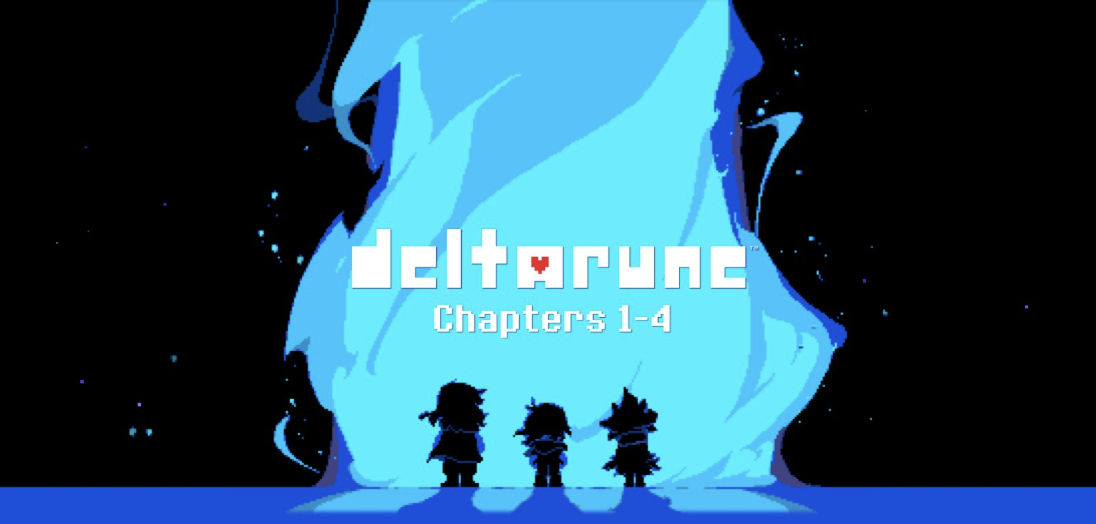
In the indie gaming sphere, you’ll be hard-pressed to find a video game that has maintained more consistent hype than Toby Fox’s Deltarune. Billed as a successor (though not necessarily a sequel) to Fox’s 2015 hit Undertale, the game follows Kris, a human teenager in a town inhabited by cartoony monsters, and their journey as they fall into a fantasy world alongside their delinquent classmate Susie and are enlisted in a quest that will determine the fate of the world. While the full paid release was made available last summer (and the demo was first released as far back as 2018), the game is being released in increments with Chapter 5 being slated for release some time this year. This review can effectively be viewed as my encouragement for readers to play the game, if solely just to catch up on the state of things before Chapter 5. I’ll try to avoid blatant spoilers.
Now, if the fact that I’m writing a review for a game that’s technically been out for seven years didn’t tip you off already… I really, really like Deltarune. This is one of the most creative, entertaining, well-written games I’ve had the pleasure of playing, and quite frankly, I couldn’t sum up every reason I like this game if I tried. So I won’t! I’ll try to keep today’s review short, but I’ll still dedicate at least a paragraph or so to each element I really want to praise.
Firstly, probably the best part of the game thus far: the writing. It takes a real master of the craft to balance humor and drama, but Toby Fox makes it look easy. Deltarune takes Undertale’s witty, offbeat sense of humor and cranks it up to eleven: every chapter is loaded to the brim with comedy gold. It takes a lot to make me laugh out loud, but Deltarune managed to do it consistently, spinning off jokes big and small at almost every twist and turn. This does absolutely nothing to discredit the very real pathos present in this game’s writing, however: behind comedic veneer lies some awesome, some heartwarming, some tragic, and some genuinely terrifying moments that come together to make an infinitely revisitable story. Deltarune’s narrative is nominally linear, but exploring around the nooks and crannies of the Dark Worlds can reveal some dark secrets leading to some of the most potent, gripping horror in the game, taking the relationship between player and game and flipping it on its head (I never said we specifically play as Kris, did I?). This is bolstered in large part by the top-notch quality of Deltarune’s characters. Every character we encounter, from random background NPCs, our very own player characters, all the way up to the bosses we battle are dynamic, layered, and three-dimensional; they all have their own pasts, their own dreams, their own little quirks that make these little game sprites feel very real. What follows is an incredibly endearing cast of characters that you become genuinely attached to.
Of course, the point of a game is to play it, and to do that you need an engaging, fun gameplay system that keeps you wanting more each time. In that capacity Deltarune arguably exceeds its predecessor, for whom the gameplay admittedly is somewhat primitive and unpolished in comparison. Deltarune takes Undertale’s Touhou Project-inspired bullet hell battle system and improves it tenfold, with more complex attack patterns, a multi-party system that allows for intricate strategy to be applied in every fight, and tons of new mechanics that make battling a more involved, fun experience than before. That’s not to discredit overworld gameplay; Fox makes traversing the Dark Worlds engaging through a slew of puzzles and hidden pathways that keep you searching for easter eggs throughout. Chapter 3 and especially 4 are the most accomplished in this regard, with endless varieties of side challenges integrating new gameplay styles as a change of pace.
And I’d be remiss not to mention the soundtrack, composed by Toby Fox himself; Deltarune’s soundtrack is one of my favorites in any video game, chock-full of intense, blood-pumping battle tracks, groovy toe-tapping overworld tunes, and some beautifully poignant themes for when the game switches on the pathos. Particular favorites of mine on the soundtrack are Black Knife, BIG SHOT, Dark Sanctuary, It’s TV Time!, Hammer of Justice, Attack of the Killer Queen, Castle Funk, Catswing, and The Third Sanctuary.
If I had to criticize, I do think Chapter 2 is a mixed bag as far as writing goes. While the new characters we meet in the Dark World are extremely charming and well-rounded (the gloriously blithe Queen and delightfully psychotic Spamton are particular standouts), the returning cast from Chapter 1 feels more two-dimensional and less refined than before – I feel like Fox was pandering too much to memes and fanbase perceptions of the characters when writing Chapter 2. Fortunately, Chapters 3 and 4 quickly course-correct with our main cast being better-written and more complex than ever before (much of the game’s best pathos comes from Chapters 3 and 4 with them), so this is a minor quibble. I also think Chapter 4’s unconventional structure of traversing through multiple Dark Worlds reduces the amount of time we have to explore and acquaint ourselves with the Dark Sanctuaries; they’re some of the most beautiful and engaging areas in the game, so reducing the amount of time spent in each detracts from really getting to immerse ourselves. And despite my praise for the gameplay, I do feel like the battle system has a balancing issue: normal fights, especially early on, are easy enough that as difficulty ramps up during the boss fights of later chapters (and particularly so with this game’s infamously brutal secret bosses), players might find themselves caught off-guard. Ultimately, though, I think what’s good about the game greatly balances out its flaws.