Longtime readers of the Flame (as in whoever was reading back in 2024) may recall my two-part dive into the history of video game movie adaptations. As fun as it would be to do a Part 3 following up on the conclusion to see if my prediction of the “video game movie curse” dying out bore fruit, I don’t think there’s been enough new video game movies released since that article to make anything sufficient yet. For today’s review I want to instead follow up on one movie in particular that I mentioned. At the beginning of that series I briefly touched upon the Five Nights at Freddy’s film (based on the horror game series created by Scott Cawthon), my main inspiration for the article (even though in hindsight it barely factored into either part). Two years later and on December 5, 2025, the hotly anticipated sequel to the Five Nights at Freddy’s film premiered in the wake of an extensive months-long hype campaign. Set around a year after the first film’s story, this one follows the aftermath of the first film’s traumatic events and the horrors surrounding Freddy Fazbear’s Pizza: not only have resurfaced rumors of haunted animatronics gripped the local town in a Fazbear frenzy, but a whole slew of animatronics from the original restaurant escape to wreak havoc, under the control of the vengeful spirit of a serial killer’s victim. SPOILERS AHEAD. YOU HAVE BEEN WARNED.
Before I get into discussing the film, I think it’s important to divide my judgment on it into two camps: judging it as a film overall, and as a Five Nights at Freddy’s film specifically. Because, to give away my overall judgement of this movie before I even give my criticisms, from the perspective of judging it as a film with a plot and characters it is laughably bad. But through the lens of it as a Five Nights at Freddy’s film, aside from a few rather iffy points it’s a sigh of relief for certain (if you know the track record of video game movie adaptations). I’ll try to avoid leaning towards that side of things in this review, as I am aware most readers of the Flame are probably not dedicated fans of this franchise, but it will make its way into some of my judgments on this film.
Moving onto, y’know, actually talking about the film, I want to start off with my problems with it. Because despite my relatively neutral tone thus far, I think this film has major flaws on multiple levels. The biggest overarching issue is the plot… or, lack thereof. Because aside from a couple narrative throughlines, this film doesn’t have a plot so much as it has generally sequential scenes that lead into each other but otherwise serve no real purpose to actually progressing the story forward, all while playing hopscotch with a minefield of plot holes.
Pro tip, Scott Cawthon: the science fair B-plot shouldn’t switch gears to become the main plot for the middle third of the film (conversely, the A-plot of murderous animatronics wreaking havoc, the actual plot of this movie, should probably take up more screentime overall than getting shoved into the back half of the film). These overall script problems culminate in the ending, perhaps one of the most baffingly rushed, overloaded yet skimmed-through endings I’ve seen in a movie. Simultaneously so much and so little happens in this scene that it boggles the mind. The ending, in rough summation: fails to actually conclude the antagonist’s storyline, suddenly brings back a character from the beginning of the film and reveals him as the new main antagonist before he gets chased off just as quickly as he appeared, brings back the original animatronics only for them to straight up die barely a minute afterward, and immediately ends on a cliffhanger. And believe you me, if you think this sounds confusing and like a convoluted Frankenstein of random sentences, I am deliberately simplifying it. Watching this ending in the cinema, I could just feel the dawning, gut-sinking sensation of dread as I slowly realized that this was how this movie was ending. The ending is easily the worst part of the movie, precisely because of how much it exposes the flaws. Despite everything, I was genuinely enjoying myself so much throughout the movie that I didn’t really care about what I was tenuously acknowledging as flaws, but the ending just baffled me so much that it took me out of my immersion and left me much wiser to the problems in the script. It also leaves me worried for the third film: this film is already setting up the antagonist of the third game, the monstrous Springtrap, as the next installment’s villain; having the Marionette, this film’s foe, stick around for the third movie risks overcomplicating the plot and taking away focus from the next film’s villain. As we have learned from this movie, complexity addiction kills.
There’s a few other glaring problems with this film, mostly involving characters being underutilized: while our main characters get a good amount of focus as necessary, others get shafted pretty badly. This is most evident with two characters in particular: Henry, father of the murdered Charlotte Emily and former business partner of serial killer William Afton; and Michael Afton, the son of William. In the case of the former, I was going into the movie expecting him to be a much more important character who would play a bigger role, and was sorely disappointed to see him only receive a couple scenes, only one of which even featured him in the flesh. It’s a severe waste of both Skeet Ulrich’s acting talent and the character’s fascinating potential as a remorseful man trying to atone for his mistakes through bringing down his murderous former friend and vengeance-driven daughter; it would have been extremely easy to have him be the one to appear at the end of the film to drive off the Marionette and confront his daughter’s vengeful spirit, but apparently an emotionally-effective character moment is off the cards for this one.
As for Michael Afton, I have a theory that he’s a fugitive of an earlier draft of the film where he was the main antagonist full-time and somehow survived every revision of the script, because to call his character out of place does not cut it: he only appears in one scene in the first act before returning out of the blue at the end to suddenly reveal who he is and that he’s the bad guy behind the animatronics all along (despite Charlotte already being clearly established to be controlling them), before getting punched out and slinking away while nobody notices. I wholeheartedly think that he could be cut from this movie’s plot and nothing would change in any significant way. It’s a shame too, because the son of the prior film’s villain being desperate for his father’s approval and trying to follow in his villainous footsteps is a genuinely interesting direction to take the character in, with Freddy Carter’s acting adding some much-needed depth to the character as is. His execution in the film’s final cut, though, certainly left much to be desired.
Similar problems arise with the film’s animatronic characters. The first movie could get away with limiting the number of animatronic scenes, both due to the low number of animatronic characters and its status as an introductory point to the series for newcomers requiring it to not overwhelm the audience with increasingly obscure top-hatted animatronic bears. This second movie, inheriting the second game’s infamously huge cast, does not have that same luxury. And despite having the vast potential held within utilising the animatronics, including some of the most iconic ones from the series, their screentime is both limited and uneven: some individual characters get the lion’s share of screentime and plot relevance, while others are lucky to get a minute onscreen. This lack of focus on the animatronic characters reeks of wasted potential and makes them less effective as threats: we can’t get a proper gauge on how threatening they are if only a few of them are actively posing a threat for most of the film, and by the time they actually go on the warpath it feels too little, too late, barring a couple moments.
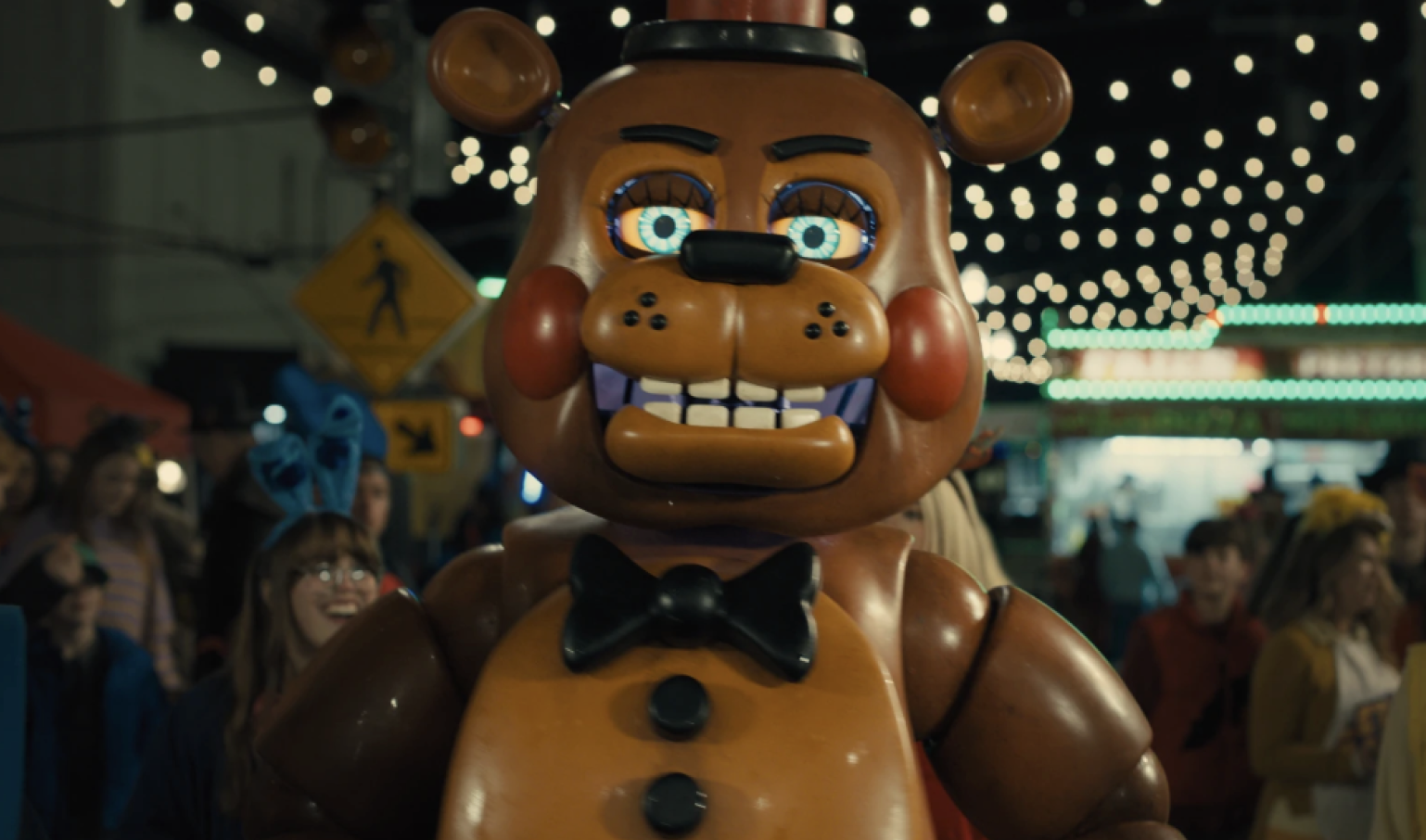
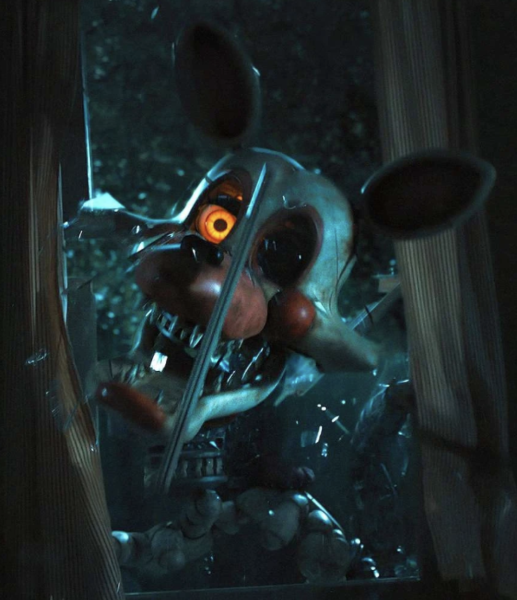
Hoo boy, that was a lot. At this rate we’ll never figure out if this movie actually has any redeeming qualities. Does it? Let’s see. The practical effects are, like the first movie, still phenomenal: Jim Henson’s Creature Shop and their ability to create animatronics that are both extremely accurate to the original games and still function perfectly remains unmatched, especially regarding the second game’s more complex designs like the spindly Marionette and aptly-named Mangle. All actors deliver good to great performances, buoying the script and their characters with charm, depth, and believability, with Elizabeth Lail, Matthew Lillard, and Skeet Ulrich being particular standouts. If I have to complain again, though, leading man Josh Hutcherson feels low-energy for most of the film, even if that’s mostly down to the dip in his writing quality in this film – when the action kicks in he gets to be entertaining again.
In comparison to the first film, this one is much more confident in being a horror film, at least in the sense of the scare volume: while the first film’s scary scenes were much rarer and cut back on the explicit gore in favor of implication, this one has multiple scenes dedicated to animatronic terror and much more visceral (though not overtly explicit) implications of gore and death (this is one of the few movies I’ve seen with the guts to have a child bleed out and die onscreen), and a much more consistently tense atmosphere. I might have griped about their underutilization, but when the animatronics get moving they feel like real, consistent threats; compare it to the first movie, where their threat level was undermined by scenes of them being openly friendly to our protagonists without any sinister motives behind them. Whether this is to its benefit or detriment is a matter of debate: while the first movie, in my opinion, managed to makes its few overt horror scenes much more suspenseful than this film makes its equivalent scenes, this one manages to sustain that air of tension for longer throughout the film, and with greater efficacy.
There’s a sequence where Lail’s character Vanessa forces herself into a nightmare to confront her own fears that’s genuinely very effective at creating tension and fear (perhaps, ironically enough, through using the very human threat of her abusive father rather than an ineffable machine), and some of the scenes in the abandoned pizzeria where Hutcherson’s character Mike Schmidt has to fend of waves of incoming animatronics serve as a lovely extended reference to the gameplay of the original game that keeps the tension high and momentum quick. It’s very much a movie to be enjoyed more than one to apply critical thought about, despite the writer’s best intentions.
C’mon. You knew I had to make the joke.