A Bit of History…
The world of music has seen an extensive amount of controversy, from strange lyrics to celebrity scandals, old and new. This is because music is always adapting, always developing and advancing to fit in a world that switches gears like a bike. The evolution of Music has 4 main key points in history. The first one, ancient and early music, has a long history. Evidence suggests that it probably existed for as long as humanity itself, instruments dating back to the Upper Paleolithic Era (about 40,000 years ago), like bone flutes found in Germany. Not to mention vocalization that researchers believe could possibly date back to 400,000 years ago. The second key point follows the emergence of written musical notation (around 1040 CE) and the Medieval Era, with the development of more polyphonic music in the Renaissance and Baroque Period. The 20th century saw the third point that brought a huge musical expansion of style, artist, and before that was the classical and romantic musical eras (think symphonies and sonatas).
The fourth main point was the rise of the digital era. Around the mid 20th century, conceptual foundations were set up by early experimenters and sound analysts looking at synthesis and electronic music through seemingly old and mundane looping systems like tape recorders and generators. Famous musicians and producers include Edgard Varèse, Pierre Schaeffer, and Karlheinz Stockhausen. Things began to pick up pace a bit in the late 1970s-1980s with the transition to commercial digital music and CDs (Compact Discs), made through digital recording systems. The 1980s saw the development of MP3 for audio data compression (Karlheinz Brandenburg, a German electrical engineer, was one of the primary people who drove this development). Widespread adoption from the consumer side of the digital age of music gained momentum with the internet, legal digital download platforms (Apple iTunes, 2003), and later streaming services like Spotify and Apple Music.
All of these eras are notable and separate from each other because they were shaped by their surroundings.
Changes in music are correlated to changes in the world.
I use the term “world” very generally here. The creation of Digital Audio Workstations (DAWs) brought recording software and online, computer based music studios that allow artists to record, edit, and mix music from their own computers!
Musical formatting like MP3 and AAC efficiently compressed and stored the sound, allowing for easier sharing and portability for devices. The internet became the primary conduit for musical distribution and led to shifts in music platform models economically. All of this lets listeners gain access to hundreds of millions of songs and let artists reach global audiences (without a major record label).
And yes. There are drawbacks, and most notably is the emphasis on profitable music. Generally in MP3 storage, the sound optimizes space via compression over the quality of the sound, a cheat for profit. The market saturation and competition with algorithm dependence (especially when artists depend on social media to promote their music) tends to be toxic in ways that reduce the music to its creator or its platform or the latest social media trend. There is also something deeper, a more sentimental loss, when the physical sense of music (vinyls, tapes, tangible products) fades into files online.
But all of this is a response to let music continue to build in a world heavily influenced by technological advancement. It is as evolution has it; music is not a linear process.
What is MIDI?
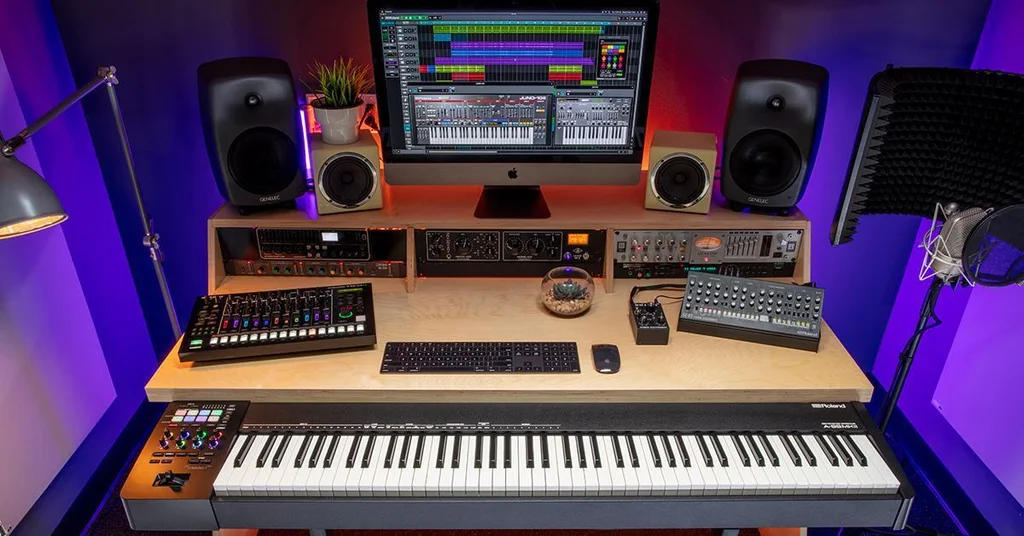
MIDI is a fancy acronym for Musical Instrument Digital Interface, which is a fancy term for the communicative system between electronic musical instruments (like synthesizers), computers, samplers, and other devices. This link is not an audio, but rather provides data like pitch, velocity, and note tempo. It’s a control system that allows musicians to produce music, record performances, and re-record audio.
Thorough MIDI setup (keyboard, computer, analog synthesizer) – From an article by Eloy Caudet
MIDI can meticulously focus on the structure and texture of the music, controlling every aspect of the sound, from the tone to the pitch to the dynamics to the duration and velocity of a single drum beat.
Who are MIDI Musicians?
“MIDI Musician” is a very loose and halfway inaccurate term.
MIDI musicians are not a single, distinct type of musician in the general sense of playing an instrument. They are a diverse range of producers, composers, instrumentalists, and electronic artists, who use MIDI as their primary tool to create music. The most common association is electronic music producers (think EDM, Hip-Hop, Pop), who tend to use DAWs to create synth lines, sequence beats, sample sounds, arranging and mixing entire tracks electronically. However, movie and gamemakers often use MIDI for the modern scoring of their films and games. Sometimes they will create full orchestral tracks solely on DAWs, and sometimes they will record the performance and then edit it using MIDI. Other studio musicians and session players often will connect their physical instruments to MIDI systems during a recording session. For example, a keyboardist might layer several different synth loops for a single take. Even live performers use MIDI in real-time performances! They could use MIDI foot controllers to switch guitar effects or sync the lighting in time with the music.
Solo artists tend to use loop pedals to give a larger harmonic effect. In this sense, a “MIDI musician” is simply a musician who uses digital tools to create expression and don multiple roles from a traditional composer to a sound engineer.
What does all of this mean?
It means that MIDI musicians combine a high degree of musical knowledge and artistry in order to create music that can blur the boundaries between composition and production. They use complex skills of technical arrangement and experimentation to design sound, and they are able to do this because of technological evolution in the industry. MIDI software is a tool used so much in musical production today to give musicians an audience. Even in a musical world that seems so different from the past, music would not have any significance without people. People listen, people create music, people build connections through music, and then we can realize that sometimes you can be the musician and the audience at the same time. That hasn’t changed throughout history, and it (maybe) won’t change in the future.