
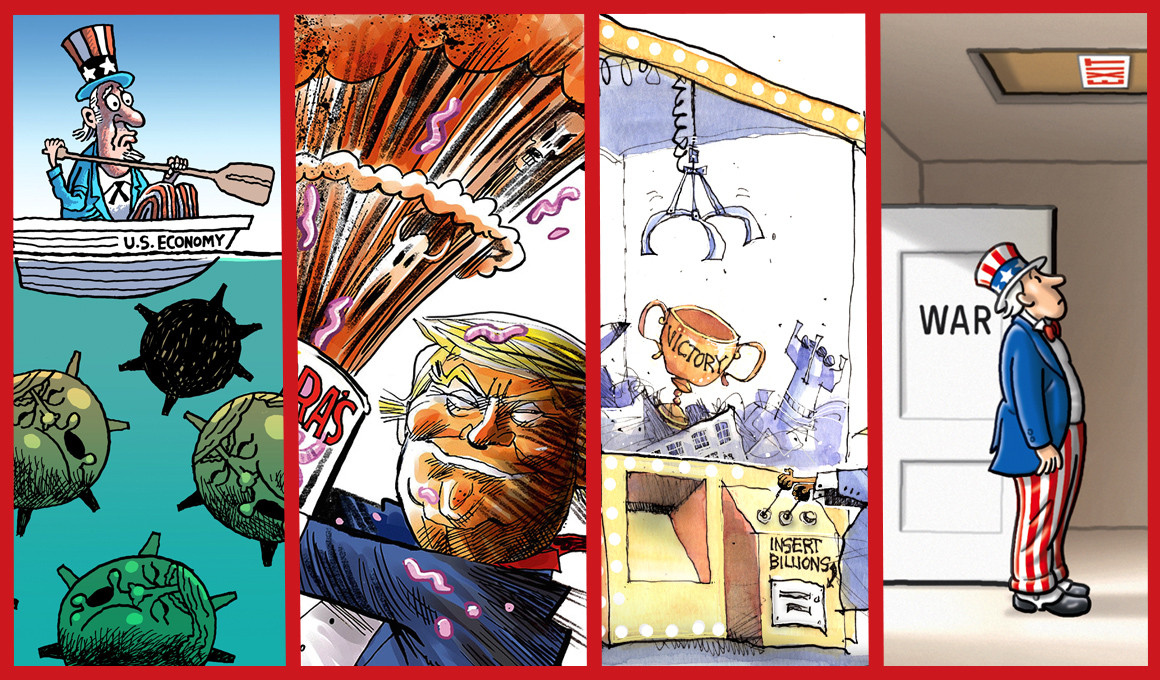
For their Unit 3 assessment in Individuals and Societies, Year 10 students were asked to do something most school assignments do not ask: take a political position and defend it visually. The task required each student to produce an original political cartoon on a topic of their choosing related to atrocity crimes, genocide, or international conflict, drawing on the historical and analytical skills developed across the unit. The results were pointed, carefully researched, and in several cases, genuinely unsettling in the best way.
The task pushed students to move beyond description. A political cartoon succeeds not by showing what happened but by making an argument about why it matters, who is responsible, and what the world chose to ignore. Getting that across in a single image, without a caption to explain it, is harder than it sounds.
Here is a look at what they made and what they were thinking.
Finley: The Language of Euphemism
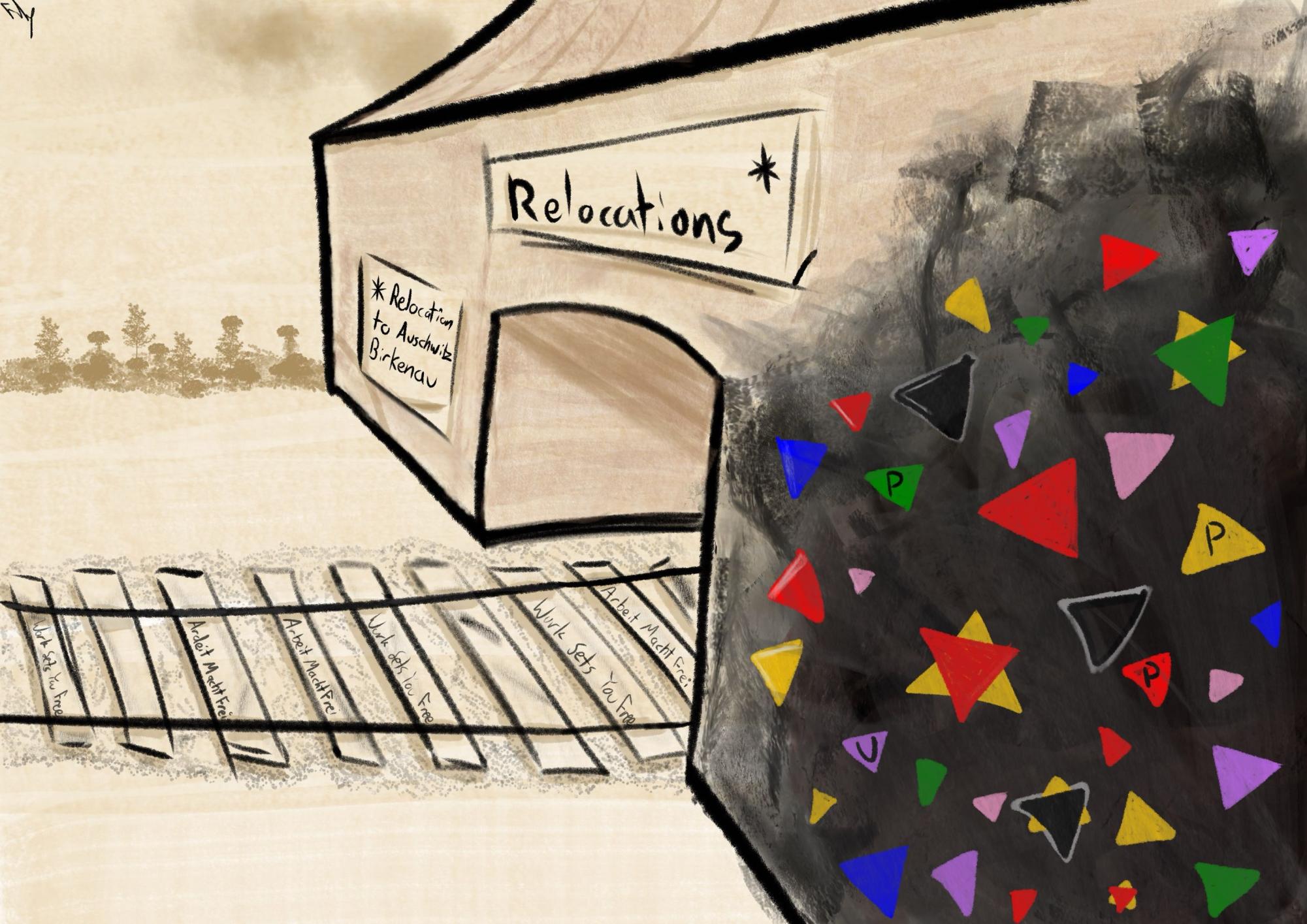
Finley’s political cartoon depicting the Nazi deportation system. Railway tracks carry the repeated phrase ‘Arbeit Macht Frei’ while coloured triangles, each marking a different victim category, scatter into darkness.
Finley’s cartoon centres on the machinery of bureaucratic deception. A sign reading “Relocations*” marks the entrance to what the footnote identifies as Auschwitz-Birkenau, the asterisk doing quiet, devastating work as the gap between official language and actual reality. Railway tracks run beneath the arch, lined with the repeated phrase “Arbeit Macht Frei” (Work Sets You Free), the slogan that greeted prisoners at the camp gates. On the right, coloured triangles scatter into black darkness, each one representing a different category of victim classified by the Nazi system: Jews, political prisoners, Roma, gay men, and others, all reduced to colour-coded insignia.
The whole cartoon is built around that gap between what was said and what was done. The word “relocation” sounds administrative, almost boring. That is the point. A lot of what made the Holocaust function as a system was the bureaucratic distance between the paperwork and the reality.
Vansh: Two Genocides, One Silence
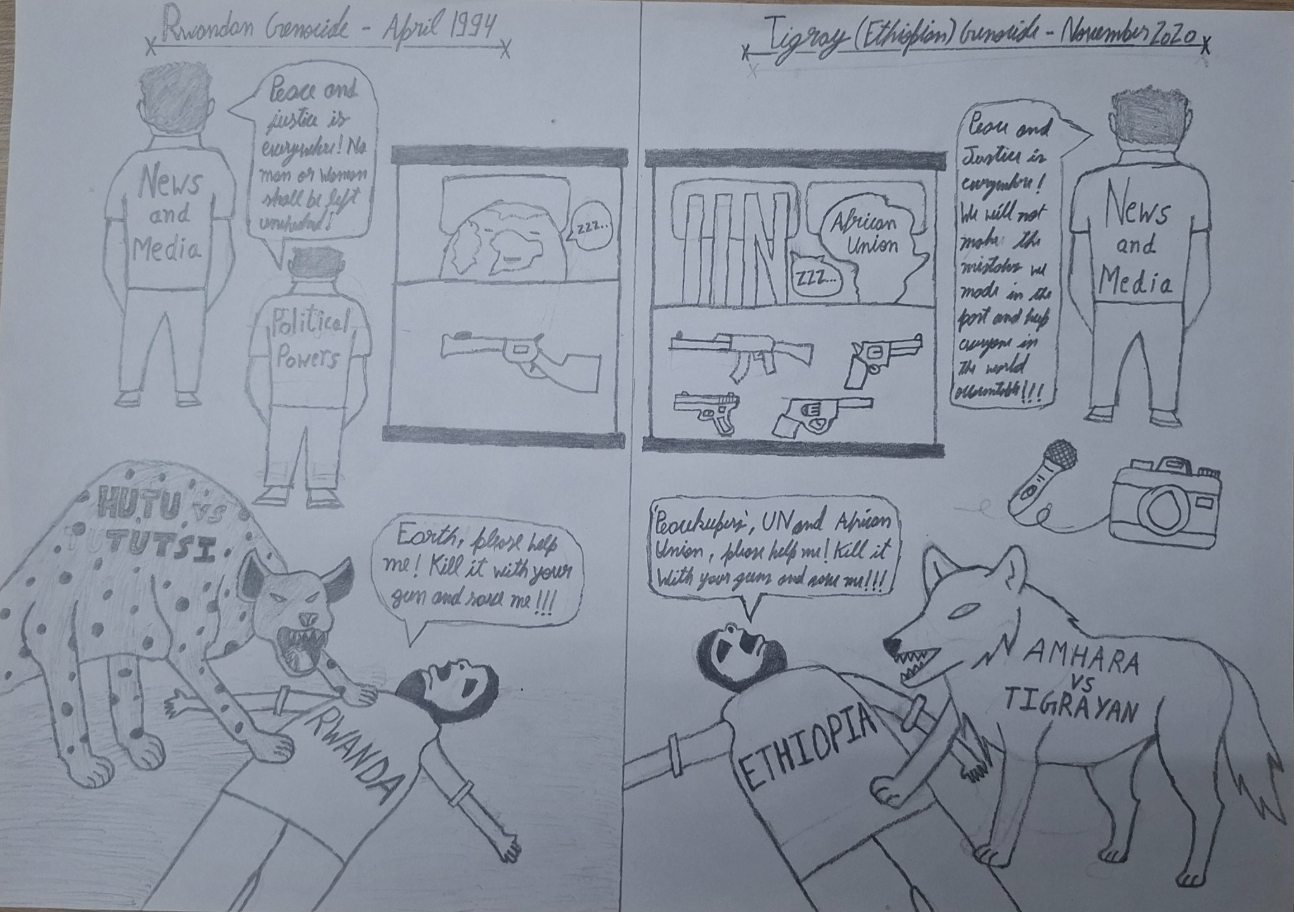
Vansh’s comparative cartoon placing the Rwandan Genocide (1994) alongside the Tigray Genocide (2020) in a split-panel format. In both panels, the world sleeps, political powers speak hollow words, and a predator devours the nation.
Vansh’s cartoon is structured as a diptych, splitting the page between the Rwandan Genocide of April 1994 and the Tigray Genocide beginning in November 2020. The visual language is consistent across both panels deliberately so. In each, a figure labelled “News and Media” turns its back. A figure labelled “Political Powers” delivers a speech about peace and justice while behind them a globe sleeps. In the foreground, a predator attacks a prostrate figure representing the nation, begging for help that does not come.
The parallelism is the argument. By drawing both genocides with the same composition, Vansh makes the case that the international community did not simply fail to learn from Rwanda. It repeated the same failure with the same structure: public statements of concern, institutional paralysis, and a media cycle that moved on. The cartoon connects to a strand of scholarship on the “genocide gap”, the distance between the post-Holocaust promise of “never again” and the actual political will to act.
“I used a lot of symbolism to show several different elements throughout the drawing, such as the media and the political powers of the world ignoring the acts, the genocide being an animal killing the nation slowly, and the world sleeping as the act is being committed, showing that they did not want to waste their resources on saving the people.”
— Vansh Khari, Year 10
Leo’s task was analytical: working through a curated collection of existing political cartoons focused on international conflicts including Rwanda, Sudan, the Israel-Hamas War, Myanmar, and the Tigray War, and producing a structured analysis of what they communicated and how.
His central finding concerned the United Nations. Across the cartoons he examined, the UN appeared repeatedly, and rarely well. Most depicted the organisation as slow to respond, constrained by political pressure, and overwhelmed by the sheer number of simultaneous crises it is expected to manage. Some cartoons acknowledged the UN’s humanitarian work, but the dominant register was criticism of an institution whose stated purpose and actual capacity are in persistent tension.
“Analysing political cartoons was a long process. The analysis involves more than simply describing what is shown in the image. In order to create a strong analysis, you have to have good general background information about the topic, identify the symbolism and satire within the image, and explain how these visual details all work together to support the overall message the cartoon is trying to deliver.”
— Leo, Year 10
Leo’s observation applies equally to the cartoons his classmates made. What makes Finley’s asterisk work is knowing what Auschwitz-Birkenau was. What makes Vansh’s parallel panels land is knowing that the international response to Tigray closely mirrored the international response to Rwanda. The image carries the argument; the context is what makes the argument legible. That combination, visual literacy and historical knowledge, is exactly what the task was designed to develop.
Stephan Anagnost • May 29, 2026 at 7:46 am
Impressive analysis & a what you can accomplish intellectually when you combine critical thinking with passion for a topic & creativity. Well done!!!