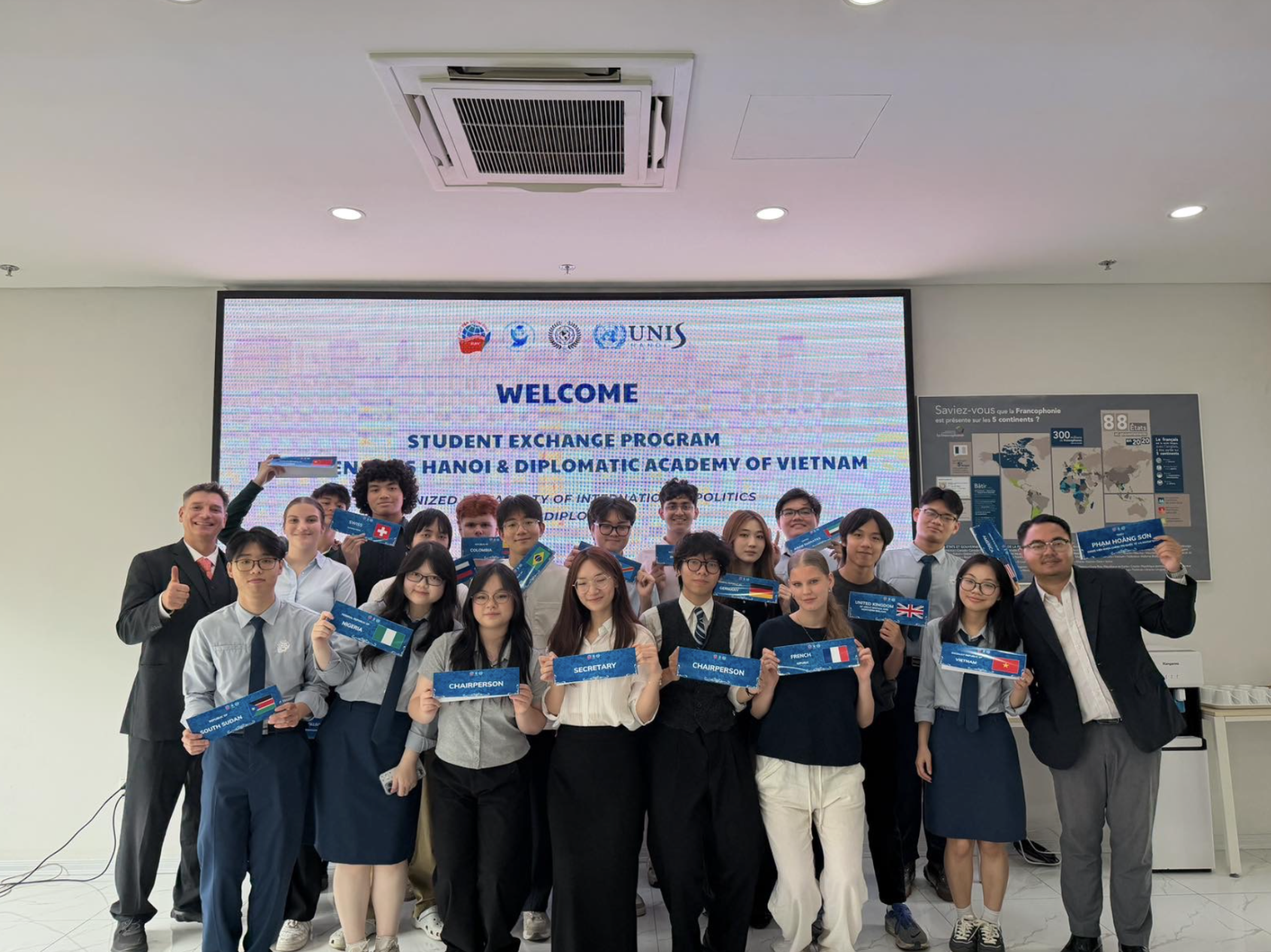
 Our cohort at the opening session of the Student Exchange Program, Diplomatic Academy of Vietnam.
On a warm morning in April, the GPS 11.01 cohort boarded a bus to Nguyen Canh Chan Street for a full-day visit to two of Hanoi’s most significant international institutions: the Diplomatic Academy of Vietnam and the Green One UN House. What the day offered was something no classroom session had managed, a direct encounter with the people and places where the theory of international relations becomes practice.
Arriving at the Academy’s gates, we were welcomed by a faculty representative who gave a brief history of the institution, founded in 1959 and now a cornerstone of Vietnam’s foreign policy community. The campus felt purposeful: quiet, orderly, and lined with the flags of nations that have engaged with Vietnam across decades of diplomacy.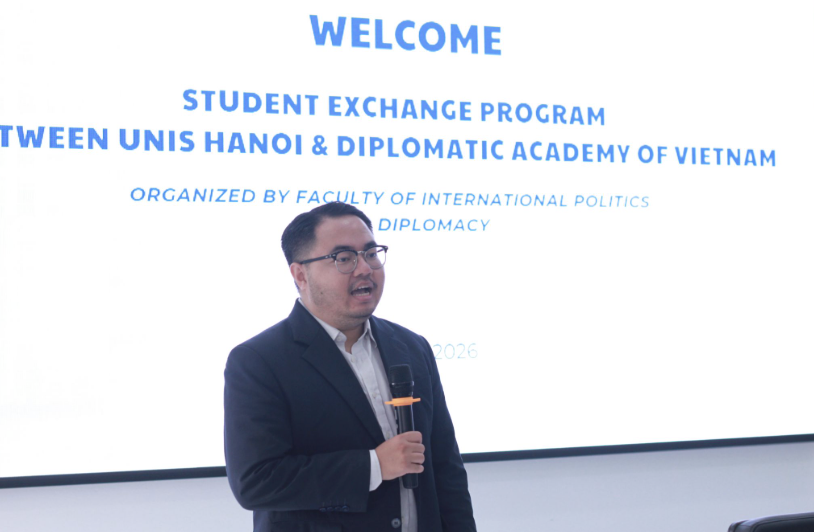 A faculty representative opens the exchange program.
The tour began at ASEAN Square, a symbolic open-air space dedicated to the ten-nation Association of Southeast Asian Nations. Flags of all member states stood in a semicircle around a central plaza. Our guide framed ASEAN as a living framework governing trade, security, and cultural exchange for over 660 million people. A faculty member connected the square to concrete policy history, including the ASEAN Agreement on Transboundary Haze Pollution, a document directly relevant to the biodiversity issues our cohort would be debating later that morning but also related to topics we were working on for our 2-year-long engagement projects.
From the square, we moved indoors to the Academy’s library, a resource centre stocked with volumes on international law, diplomatic history, security studies, and regional geopolitics. Several members of our cohort picked up publications they had never encountered in a school context, including a Vietnamese-language volume on ASEAN foreign relations covering bilateral and multilateral diplomacy across all ten member states.
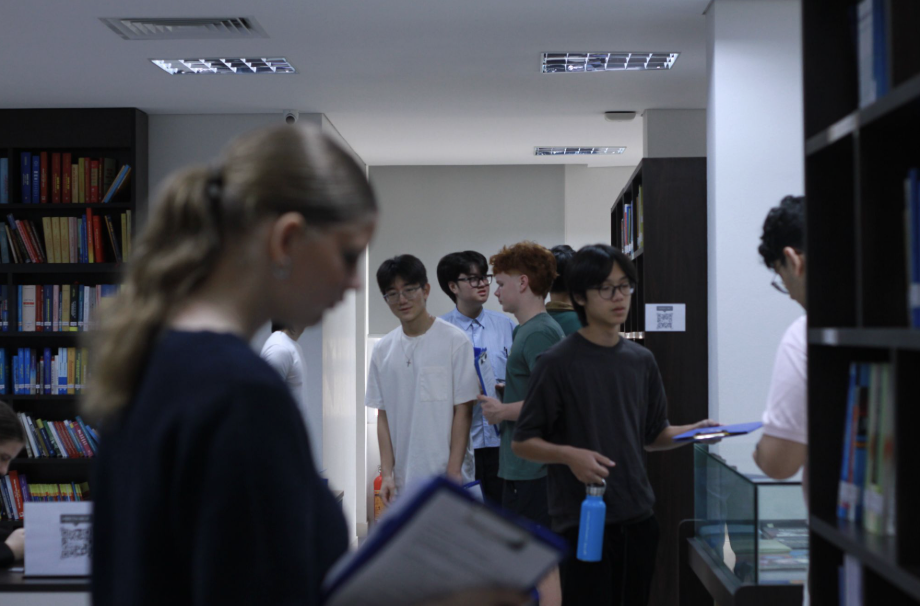 Members of our cohort browsing the DAV International Affairs Library.
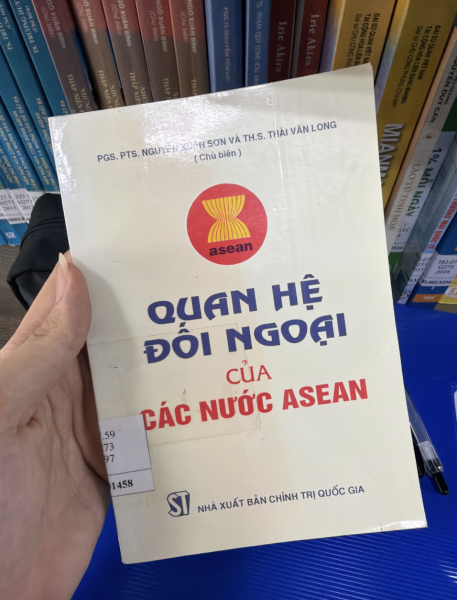 “Quan He Doi Ngoai cua cac Nuoc ASEAN”, one of several resources identified as directly relevant to our engagement projects.
The morning closed with a condensed Model United Nations session structured as the 16th Conference of the Parties to the Convention on Biological Diversity, with the topic Biodiversity Conservation in the Context of Transboundary Harm. Our cohort was divided into country delegations for two motions: the first examining enforcement gaps in cross-border biodiversity protection, the second proposing concrete cooperation mechanisms. With 1.5-minute speaker slots and a DAV student chair running proceedings with brisk formality, the session was fast and instructive. One delegate argued that the Nagoya Protocol creates compliance incentives but does nothing to stop transboundary wildlife trafficking when prosecution requires bilateral extradition agreements that most signatory pairs do not have. By the time the session closed on a consensus resolution, the exhaustion in the room was matched by a genuine sense of having worked through something real.
After the simulation, our cohort made the short journey to the Green One UN House at 304 Kim Ma Street, the first Platinum LOTUS-certified building in Vietnam and the shared headquarters of multiple United Nations agencies. Before the afternoon’s meetings, we had lunch in the UN cafeteria, a warm, hearty meal that offered a quieter moment to decompress after the intensity of the morning’s committee work.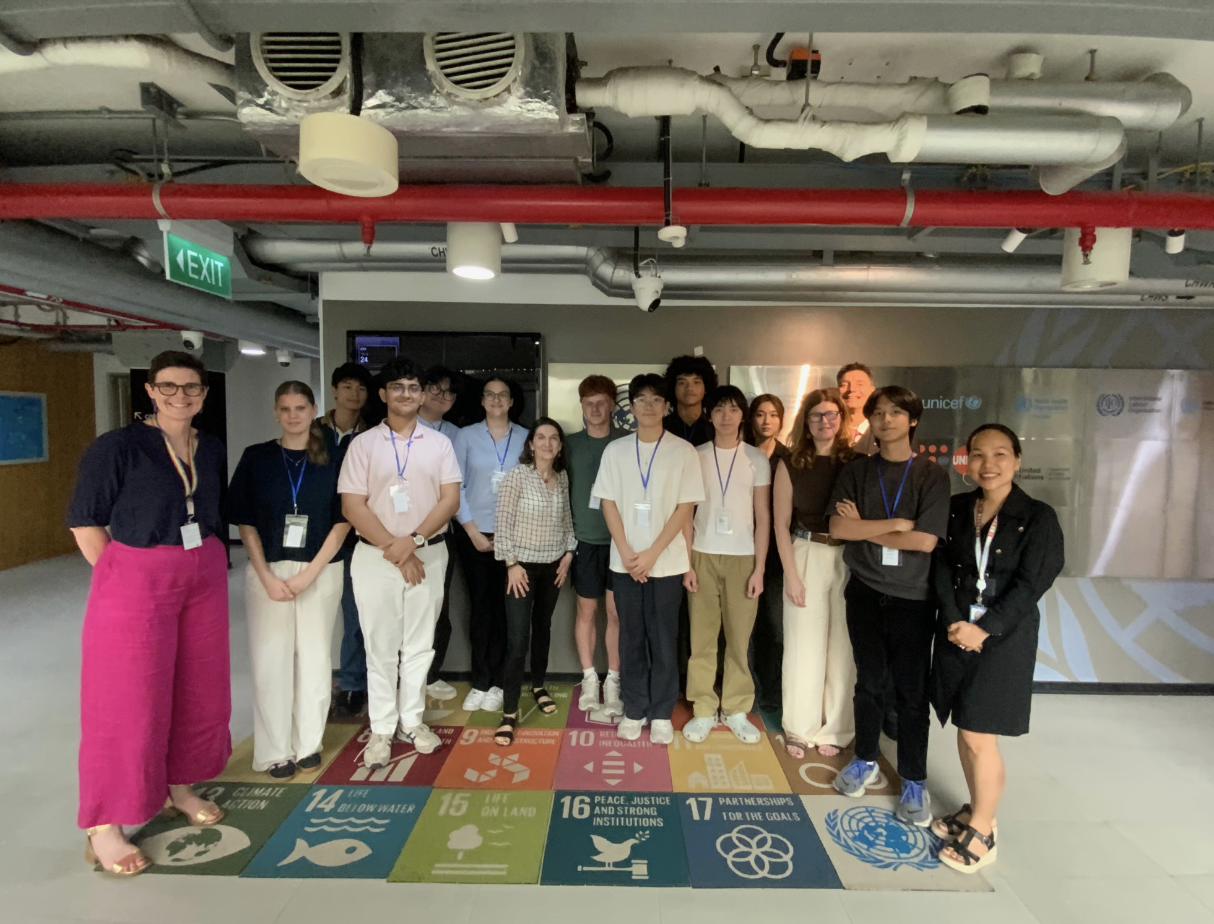 Our cohort at the Green One UN House, Hanoi.
The afternoon sessions brought us face to face with representatives from four agencies. Dr. Angela Pratt of WHO spoke about immunisation gaps in remote communities and the coordination required with Vietnam’s Ministry of Health to ensure children in hard-to-reach regions can access routine vaccinations. Silvia Danilov, UNICEF Representative in Vietnam, set the child welfare picture into context: around 2.1 million children in Vietnam still experience multidimensional poverty, and the organisation is marking both the 50th anniversary of the UNICEF-Vietnam partnership and the 35th anniversary of Vietnam’s ratification of the Convention on the Rights of the Child.
From UNFPA, programme specialist Huyen walked our cohort through the intersection of Vietnam’s rapidly ageing population, its declining fertility rate, and the unequal distribution of unpaid care work. Vietnam’s Total Fertility Rate stood at 1.91 children per woman in 2024, placing it among the world’s fastest-ageing societies. Dr. Vinod Ahuja of the FAO rounded out the afternoon with an overview of Vietnam’s Food Systems Transformation Partnership Agreement, a collaboration involving over 45 national and international partners working on agroecology, nutrition, and food waste reduction.
What struck our cohort most was the cumulative effect of hearing all four in sequence. A measles outbreak is connected to food insecurity, which is connected to gender inequality, which is connected to climate resilience. The Green One UN House makes that connection architectural, and for a group that had spent the morning arguing about transboundary biodiversity enforcement, the afternoon made clear that the hardest problems in international relations are the ones that refuse to stay inside a single committee room.
Our cohort extends its thanks to the faculty of the Diplomatic Academy of Vietnam for welcoming us, and to Angela, Silvia, Michaela, Huyen, and Vinod at the Green One UN House. Your willingness to speak honestly to a group of teenagers about the real challenges of international development gave us more than a field trip.
Stephan Anagnost • May 29, 2026 at 7:43 am
Excellent article & recap of those important visits. As someone who was a part of that expeirence, I think you captured all the takeaways nicely. Looking forward to the next follow-up!!!